|

|
|
|||
|
|
Please help support
this site by purchasing a summary of our research which includes
drawings, pictures and construction details to build the slow
sand water filters that fill this cistern. This
info has been on the net for 12 years. We do not have ads, or
annoying pop-ups here. Our sites are https.
This page on our blog has the info. $7.50 Thank
you!!
|
Update: Feb. 04, 2022:
The date is now February 4, 2022. The cistern is still holding
water. We have replaced the sill plates with non-toxic treated
cedar. The covering is now cedar. The cistern has had large tree
branches fall on it. The covering collapsed under 14 inches of
frozen snow 3 years ago. The cistern is still functional.
In this
example a DIY brick cistern is used to store filtered water. This
one holds about 9450 Litres of water. (about 2500 gallons plus or
minus 20 gallons) The blocks are filled with concrete and
re-enforced with 1/2 inch rebar. They sit on a 5 inch concrete pad
re-enforced with 1/2 inch rebar. The blocks are concrete not
pumice. The wall is built using mortar mix and standard concrete
construction procedures. It is important to note that concrete
blocks are very porous and also that the mortar joints must
be water tight. When the walls were finished, a potable water
approved water based rubber sealer was applied on the inside. The
sealer failed (see the bottom photo). In this part of the country
it is too cool and humid for this sealer to work on concrete that
is underground.
So far, covering the surface of the walls with cement mixed with #70 sand is the best sealing method for a humid cool climate. I recommend six coats of cement and 2 extra coats at the corners, over the mortar joints and at the bottom where the bricks set on the concrete pad. The total cost for this cistern was under 1200 dollars (not including labor - the largest expense was the concrete and this will vary considerably depending on where you are located - the total cost may run over 1200 dollars.) The cover is galvalume roofing material and the rain water runoff from the cover will be filtered and used in the cistern at a later point in time.
The cistern was filled for the first time starting June 11, 2010.
Update: June 2010: The rubber sealer failed in early June 2010. There was too much moisture in the concrete, and soil and the humidity was too high and the temperatures too low to allow the coating to cure at the bottom levels of the cistern. The sealer on the top levels of the structure did set up very nicely, and did function as the manufacturer stated. After removing the uncured portion of the rubber sealer, two coats of ansi-61 potable water approved portland cement was applied. This was just the portland cement with no sand added. The cement was mixed to a paste and applied with a large paint brush. Portand cement cures effectively when it is wet, and will harden under water after it has set up, but two coats was just not enough. At 90 percent full the cistern did appear to be holding the 20,000 pounds of water it was holding at the time. (8.33 pounds per gallon X 2490 gallons = 20,658.4 pounds or about 10 tons) Below are pictures of the resurfaced cistern walls. Regarding the portland cement as a sealer, I would use at least 6 coats - as the cistern has been gradually loosing water after only 3 coats.
(as of August 1, 2010 about 100 gallons had seeped out). I would recommend sealing the outside of the blocks with cement also. Another option is to just put a liner inside the tank, that way if the concrete cracks the liner will still hold the water.
May 5 2011 The extra coats of cement have been applied and allowed to "cure" and the re-filling has started. Each coat was allowed to cure for 24 hours before applying the next coat; keeping the cement moist while it was setting up. The extra coats were allowed to set up for 4 days before starting to fill. The next to last coat was done with 15 percent (by volume) #70 sand added. Two extra coats were added at wall corners and at the bottom where the blocks sit on the concrete pad. Note how the joints between each block are now just barely visible. Each coat of cement took about 1 hour to apply, and about 60 pounds of portland cement and 10 pounds of sand was used for all the extra coats.
Remember that portland cement (the name does not refer to Portland, Oregon or Portland, Maine by the way) is hydraulic - that is it hardens using water - the chemical reactions that cause portland cement to harden need water to proceed. This coating will just get harder under water. Cement hardens just fine under water. Note that type 2 portand cement was used - it is purchased in the bag without sand added - just the cement made by: Ash Grove Cement Company, 11011 Cody Street Suite 125 Overland Park, KS 66210, United States. 913-722-5998. The local supplier of that product is Mutual Materials. The cement is very inexpensive: 12.00 dollars for a 94 pound bag. Most of the cost building this cistern is labor.
Another thought here: consider using solid concrete cap blocks 4X8X16 instead of concrete blocks 8X8X16 to build the cistern (If I build another one this is the way I will do it). it will take more blocks, and more mortar, but they are solid and it will probably be easier to get a better seal with the mortar between blocks. It will not be necessary to fill them with concrete so the cost will likely not be much greater. Sealer will probably still be needed, but that is not a major expense and does not take long to apply.
June 18 2011 (Update) Concrete delivered is currently running about $110 a yard and most places will have a minimum of 3 yards. We used a line pump that went about 210 feet to the root cellar near the cistern. To fill 225 concrete blocks of the size 8X8X16 (in inches) took about 2.5 yards of cement. We were fortunate: the contractor who brought out the equipment and ordered the cement helped and set up his line pump for us. We used a 2 inch hose; and handeling it was fairly easy.
After 1 year some of the wood portions of the cistern have become infested with wet wood termites and the wood has started to mildew. The wood that was sealed with the Blue Max coating is ok. For anyone considering a cistern built like this one, I would highly recommend sealing all the wood portions with some kind of potable water approved sealer - the Blue Max sealer works very well on wood - just be sure the wood is dry before you apply it.
August 21 2011 (Update) The cistern now has no measureable leakage after 3 weeks of no added input water. The extra coats of cement (mentioned in the note above from May 11 2011) have (apparently) made the cistern water tight.
September 13 2011 (Update) The cistern still has no measureable leakage after 6 weeks of no added input water. This is the time of year we are really happy to have 2500 gallons of water stored up - temperatures have been in the 90's several days now and in the upper 80's for the past week and we have had no rain for the month of August.
November 29 2011 (Update) The cistern still has no measureable leakage after 16 weeks of no added input water. We have used about 250 gallons of water from the cistern, and it is now filling again. The water from the cistern is better than our deep well water. (The surface well that supplys the filters is now full of water again and is in operation.)
July 10, 2012 (Update) The cistern still has no measureable leakage since May 30 of 2011 (after the 6 coats of cement were applied.) The clarity of the water is better than our deep well water, and is equal to our deep well water after being filtered through a commercial 10 stage filter. There is now a small DC pump (which is able to run off the grid on solar power with a battery backup) hooked up to the cistern and the water pressure/supply is equal to that of the deep well. A UV filter is now all that is needed to assure highly pure potable water. Keep in mind that the water that goes through a properly functioning slow sand filter has the pathogens, including Cryptosporidium (Cryptosporidiosis) and Giardia lamblia (Beaver Fever) cysts,removed - not just killed (see Frequently asked questions regarding slow sand filters: faq number 3 on this website). Rapid sand filtration combined with chlorine or ozone (used by most public water utilities) only kills pathogens and is realitivly ineffective against cryptosporidium and beaver fever cysts.
August 6, 2012:
The BlueMax coating did fail on the bricks because of too much moisture in the soil, however, Ames research makes another coating specifically for brick that is also potable water compliant. I think it is worth checking out the sealer designed for bricks, as a rubber coating is (should be) more flexible and will not (should not) crack as easily as a cement coating.
December 6 2012 (Update) The cistern still has no measurable leakage since May 30 of 2011 (after the original 6 coats of cement were applied). The water quality has remained excellent; with several exceptions - some insects have found their way into the cistern, and at the height of summer, the surface of the water has some slight accumulation of discoloration - a film of sorts - it remains on the surface. This is gone when fresh water from the filters is circulated through the cistern. Since we use slow sand filters to feed the cistern, water must flow continuously through the system at about 40 liters per hour - easily done by the small battery powered electric pump. This could also be done manually (about 5.5 gallons twice a day). A better seal where the roof sits on the walls is in order. Note that this cistern is located in the forest far from any city; in a wet, and often humid, mild climate; where there is plenty of wildlife.
Update; March 7, 2013:
At nearly 3 years old (32 months of service so far), the cistern is still holding water without leaking. The entire month of January brought below freezing temperatures here (upper 20's to 30 daytime deg. F ; lower 20's night time deg. F), but the cistern and the two filters that feed it kept flowing, and the overflow did not freeze. There is an overflow that allows the water to circulate constantly through the cistern. The overflow drains into a 400 gallon pond nearby. The water there is also crystal clear and is filtered again by another slow sand filter.
Update; August 27, 2013:
No major leaking. The cistern is still holding water. We have had no significant rainfall Since the beginning of June. The water quaity in the cistern continues to be excellent.
Update; November 10, 2013:
Some water has evaporated, some has actually been used, and some, no doubt has leaked out - about 100 gallons total. The seasonal well that supplies the cistern with water is still dry. No water has been added to the cistern since the beginning of July, 2013. The water quality in the cistern continues to be excellent, with the exception of the thin film that forms on the top of the water.
Update; January 21, 2014:
The cistern is still holding water without any significant leakage. The shallow well that supplys the water for the filters that feed the cistern filled as of mid December. The water has been flowing through the filters and into the cistern since the first of this month. This past 8 months has brought only a record low amount of rainfall. We are very fortunate to have this 2500 gallon cistern full of fresh water.
Update; June 15, 2014:
The cistern is still holding water with no detectable leakage. The two slow sand filters continue to keep the cistern full. The shallow well went dry the first part of this month. April and May had very low rainfall amounts, even though March had a record high rainfall total. The water is now being recirculated through the slow sand filters. By the end of this month the water will be exceptionally clean, as it has been every year since 2010.
Update; October 21, 2014:
The cistern is still holding water. The plywood that is covered by the metal roofing is taking a real beating. It will need to be replaced next summer. The water is still being recirculated through filter 2 and 3, as the surface well that feeds filter 2 and filter 3, is still dry. Hopefully within the next 2 or 3 weeks we will be back to filtering well water as the water table rises.
Update; March 20, 2015:
The cistern is still holding water, with no obvious leakage. The middle of November of 2014 brought enough rain to fill the surface well, and water has been running through the filters into the cistern since then. There is an overflow that allows water to be continuously circulated through the system without overfilling the cistern. This is necessary as water must be continuously run through the filters. This means fresh water is continuously flowing into the cistern.
At the end of summer 2012 and throughout that fall, there was an issue with a very thin film forming on the surface of the water (the surface well that feeds the cistern through the slow sand filters goes dry in the summer - more on that later). Since then, when the rains came and the well filled with water again for the season, the two slow sand filters that feed the cistern have been running constantly at about 50 liters per hour (13 gallons per hour) total (for the two combined), the water has cleaned up completely and is now crystal clear. If not more than 50 liters per hour (average) is used, the cistern will not dry up. It is quite comforting to know the water will be there for use when we get the long hot dry spells that often happen here in the summer. Contrary to popular belief, western Washington state can get very hot and dry in the summer. There have been times when we have had 100 degree temperatures here for several days and 90 degree heat is not uncommon at all in the summer. (Yes it probably would be possible to get the Blue Max sealer to set up in 90 degree hot dry weather here; but timing is everything - the sealer must be applied during the hot spell and it must last long enough to allow the material to set up, and the soil around the bricks must be dry and stay dry long enough for the sealer to set up and cure completely.) The bricks that were above ground here did allow the Bue Max to set up just fine. From this we might conclude: as long as it does not rain, the bricks are dry, the temperature remains within the manufacturer's specs., and the cistern is built like a basement foundation and sealed before it is backfilled; the problem of soil moisture preventing the sealer from curing would possibly be alleviated. In spite of all the issues, in areas that get significant rainfall in the winter, and hot dry weather in the summer; a cistern like this is a very good idea.
WARNING: Water is very heavy. This small cistern contains over 10 tons of water. I have purposely over-built this structure and placed over half of it underground. If you plan to build a concrete block cistern, or any kind of water container above ground that will contain more than several hundred gallons of water have a qualified engineer help you with the design. An accidental rupture or any kind of accident with thousands of pounds of water in a container would be extremely hazardous. You have been advised.
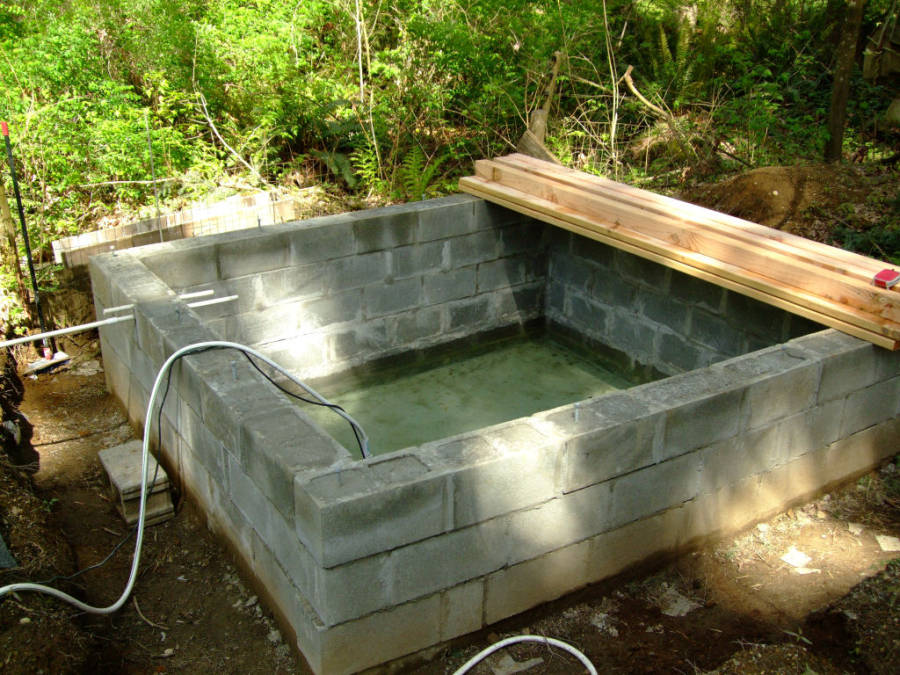
Below are pictures from Late April and early May 2010:
So far, covering the surface of the walls with cement mixed with #70 sand is the best sealing method for a humid cool climate. I recommend six coats of cement and 2 extra coats at the corners, over the mortar joints and at the bottom where the bricks set on the concrete pad. The total cost for this cistern was under 1200 dollars (not including labor - the largest expense was the concrete and this will vary considerably depending on where you are located - the total cost may run over 1200 dollars.) The cover is galvalume roofing material and the rain water runoff from the cover will be filtered and used in the cistern at a later point in time.
The cistern was filled for the first time starting June 11, 2010.
Update: June 2010: The rubber sealer failed in early June 2010. There was too much moisture in the concrete, and soil and the humidity was too high and the temperatures too low to allow the coating to cure at the bottom levels of the cistern. The sealer on the top levels of the structure did set up very nicely, and did function as the manufacturer stated. After removing the uncured portion of the rubber sealer, two coats of ansi-61 potable water approved portland cement was applied. This was just the portland cement with no sand added. The cement was mixed to a paste and applied with a large paint brush. Portand cement cures effectively when it is wet, and will harden under water after it has set up, but two coats was just not enough. At 90 percent full the cistern did appear to be holding the 20,000 pounds of water it was holding at the time. (8.33 pounds per gallon X 2490 gallons = 20,658.4 pounds or about 10 tons) Below are pictures of the resurfaced cistern walls. Regarding the portland cement as a sealer, I would use at least 6 coats - as the cistern has been gradually loosing water after only 3 coats.
(as of August 1, 2010 about 100 gallons had seeped out). I would recommend sealing the outside of the blocks with cement also. Another option is to just put a liner inside the tank, that way if the concrete cracks the liner will still hold the water.
May 5 2011 The extra coats of cement have been applied and allowed to "cure" and the re-filling has started. Each coat was allowed to cure for 24 hours before applying the next coat; keeping the cement moist while it was setting up. The extra coats were allowed to set up for 4 days before starting to fill. The next to last coat was done with 15 percent (by volume) #70 sand added. Two extra coats were added at wall corners and at the bottom where the blocks sit on the concrete pad. Note how the joints between each block are now just barely visible. Each coat of cement took about 1 hour to apply, and about 60 pounds of portland cement and 10 pounds of sand was used for all the extra coats.
Remember that portland cement (the name does not refer to Portland, Oregon or Portland, Maine by the way) is hydraulic - that is it hardens using water - the chemical reactions that cause portland cement to harden need water to proceed. This coating will just get harder under water. Cement hardens just fine under water. Note that type 2 portand cement was used - it is purchased in the bag without sand added - just the cement made by: Ash Grove Cement Company, 11011 Cody Street Suite 125 Overland Park, KS 66210, United States. 913-722-5998. The local supplier of that product is Mutual Materials. The cement is very inexpensive: 12.00 dollars for a 94 pound bag. Most of the cost building this cistern is labor.
Another thought here: consider using solid concrete cap blocks 4X8X16 instead of concrete blocks 8X8X16 to build the cistern (If I build another one this is the way I will do it). it will take more blocks, and more mortar, but they are solid and it will probably be easier to get a better seal with the mortar between blocks. It will not be necessary to fill them with concrete so the cost will likely not be much greater. Sealer will probably still be needed, but that is not a major expense and does not take long to apply.
June 18 2011 (Update) Concrete delivered is currently running about $110 a yard and most places will have a minimum of 3 yards. We used a line pump that went about 210 feet to the root cellar near the cistern. To fill 225 concrete blocks of the size 8X8X16 (in inches) took about 2.5 yards of cement. We were fortunate: the contractor who brought out the equipment and ordered the cement helped and set up his line pump for us. We used a 2 inch hose; and handeling it was fairly easy.
After 1 year some of the wood portions of the cistern have become infested with wet wood termites and the wood has started to mildew. The wood that was sealed with the Blue Max coating is ok. For anyone considering a cistern built like this one, I would highly recommend sealing all the wood portions with some kind of potable water approved sealer - the Blue Max sealer works very well on wood - just be sure the wood is dry before you apply it.
August 21 2011 (Update) The cistern now has no measureable leakage after 3 weeks of no added input water. The extra coats of cement (mentioned in the note above from May 11 2011) have (apparently) made the cistern water tight.
September 13 2011 (Update) The cistern still has no measureable leakage after 6 weeks of no added input water. This is the time of year we are really happy to have 2500 gallons of water stored up - temperatures have been in the 90's several days now and in the upper 80's for the past week and we have had no rain for the month of August.
November 29 2011 (Update) The cistern still has no measureable leakage after 16 weeks of no added input water. We have used about 250 gallons of water from the cistern, and it is now filling again. The water from the cistern is better than our deep well water. (The surface well that supplys the filters is now full of water again and is in operation.)
July 10, 2012 (Update) The cistern still has no measureable leakage since May 30 of 2011 (after the 6 coats of cement were applied.) The clarity of the water is better than our deep well water, and is equal to our deep well water after being filtered through a commercial 10 stage filter. There is now a small DC pump (which is able to run off the grid on solar power with a battery backup) hooked up to the cistern and the water pressure/supply is equal to that of the deep well. A UV filter is now all that is needed to assure highly pure potable water. Keep in mind that the water that goes through a properly functioning slow sand filter has the pathogens, including Cryptosporidium (Cryptosporidiosis) and Giardia lamblia (Beaver Fever) cysts,removed - not just killed (see Frequently asked questions regarding slow sand filters: faq number 3 on this website). Rapid sand filtration combined with chlorine or ozone (used by most public water utilities) only kills pathogens and is realitivly ineffective against cryptosporidium and beaver fever cysts.
August 6, 2012:
The BlueMax coating did fail on the bricks because of too much moisture in the soil, however, Ames research makes another coating specifically for brick that is also potable water compliant. I think it is worth checking out the sealer designed for bricks, as a rubber coating is (should be) more flexible and will not (should not) crack as easily as a cement coating.
December 6 2012 (Update) The cistern still has no measurable leakage since May 30 of 2011 (after the original 6 coats of cement were applied). The water quality has remained excellent; with several exceptions - some insects have found their way into the cistern, and at the height of summer, the surface of the water has some slight accumulation of discoloration - a film of sorts - it remains on the surface. This is gone when fresh water from the filters is circulated through the cistern. Since we use slow sand filters to feed the cistern, water must flow continuously through the system at about 40 liters per hour - easily done by the small battery powered electric pump. This could also be done manually (about 5.5 gallons twice a day). A better seal where the roof sits on the walls is in order. Note that this cistern is located in the forest far from any city; in a wet, and often humid, mild climate; where there is plenty of wildlife.
Update; March 7, 2013:
At nearly 3 years old (32 months of service so far), the cistern is still holding water without leaking. The entire month of January brought below freezing temperatures here (upper 20's to 30 daytime deg. F ; lower 20's night time deg. F), but the cistern and the two filters that feed it kept flowing, and the overflow did not freeze. There is an overflow that allows the water to circulate constantly through the cistern. The overflow drains into a 400 gallon pond nearby. The water there is also crystal clear and is filtered again by another slow sand filter.
Update; August 27, 2013:
No major leaking. The cistern is still holding water. We have had no significant rainfall Since the beginning of June. The water quaity in the cistern continues to be excellent.
Update; November 10, 2013:
Some water has evaporated, some has actually been used, and some, no doubt has leaked out - about 100 gallons total. The seasonal well that supplies the cistern with water is still dry. No water has been added to the cistern since the beginning of July, 2013. The water quality in the cistern continues to be excellent, with the exception of the thin film that forms on the top of the water.
Update; January 21, 2014:
The cistern is still holding water without any significant leakage. The shallow well that supplys the water for the filters that feed the cistern filled as of mid December. The water has been flowing through the filters and into the cistern since the first of this month. This past 8 months has brought only a record low amount of rainfall. We are very fortunate to have this 2500 gallon cistern full of fresh water.
Update; June 15, 2014:
The cistern is still holding water with no detectable leakage. The two slow sand filters continue to keep the cistern full. The shallow well went dry the first part of this month. April and May had very low rainfall amounts, even though March had a record high rainfall total. The water is now being recirculated through the slow sand filters. By the end of this month the water will be exceptionally clean, as it has been every year since 2010.
Update; October 21, 2014:
The cistern is still holding water. The plywood that is covered by the metal roofing is taking a real beating. It will need to be replaced next summer. The water is still being recirculated through filter 2 and 3, as the surface well that feeds filter 2 and filter 3, is still dry. Hopefully within the next 2 or 3 weeks we will be back to filtering well water as the water table rises.
Update; March 20, 2015:
The cistern is still holding water, with no obvious leakage. The middle of November of 2014 brought enough rain to fill the surface well, and water has been running through the filters into the cistern since then. There is an overflow that allows water to be continuously circulated through the system without overfilling the cistern. This is necessary as water must be continuously run through the filters. This means fresh water is continuously flowing into the cistern.
At the end of summer 2012 and throughout that fall, there was an issue with a very thin film forming on the surface of the water (the surface well that feeds the cistern through the slow sand filters goes dry in the summer - more on that later). Since then, when the rains came and the well filled with water again for the season, the two slow sand filters that feed the cistern have been running constantly at about 50 liters per hour (13 gallons per hour) total (for the two combined), the water has cleaned up completely and is now crystal clear. If not more than 50 liters per hour (average) is used, the cistern will not dry up. It is quite comforting to know the water will be there for use when we get the long hot dry spells that often happen here in the summer. Contrary to popular belief, western Washington state can get very hot and dry in the summer. There have been times when we have had 100 degree temperatures here for several days and 90 degree heat is not uncommon at all in the summer. (Yes it probably would be possible to get the Blue Max sealer to set up in 90 degree hot dry weather here; but timing is everything - the sealer must be applied during the hot spell and it must last long enough to allow the material to set up, and the soil around the bricks must be dry and stay dry long enough for the sealer to set up and cure completely.) The bricks that were above ground here did allow the Bue Max to set up just fine. From this we might conclude: as long as it does not rain, the bricks are dry, the temperature remains within the manufacturer's specs., and the cistern is built like a basement foundation and sealed before it is backfilled; the problem of soil moisture preventing the sealer from curing would possibly be alleviated. In spite of all the issues, in areas that get significant rainfall in the winter, and hot dry weather in the summer; a cistern like this is a very good idea.
WARNING: Water is very heavy. This small cistern contains over 10 tons of water. I have purposely over-built this structure and placed over half of it underground. If you plan to build a concrete block cistern, or any kind of water container above ground that will contain more than several hundred gallons of water have a qualified engineer help you with the design. An accidental rupture or any kind of accident with thousands of pounds of water in a container would be extremely hazardous. You have been advised.
|
2011 Cistern with the extra coats of ansi-61 concrete May 2 2011 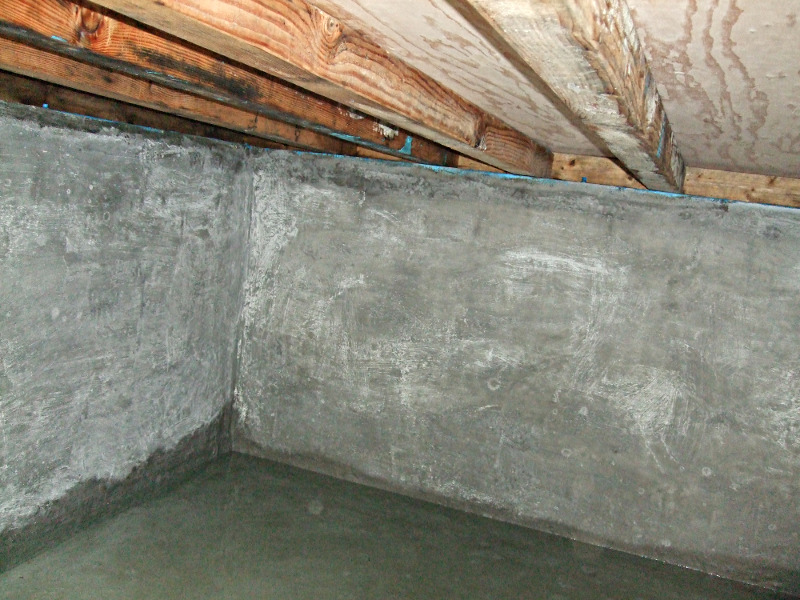 Water from the slow sand fiters is filling the cistern now: May 5 2011. 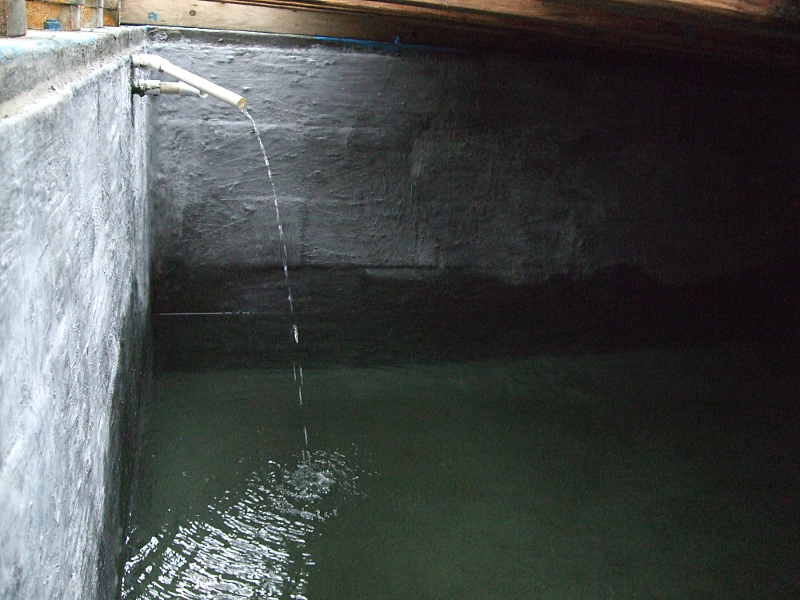 Water from the slow sand fiters is filling the cistern now: May 8 2011. The green color is from the concrete and reflections. 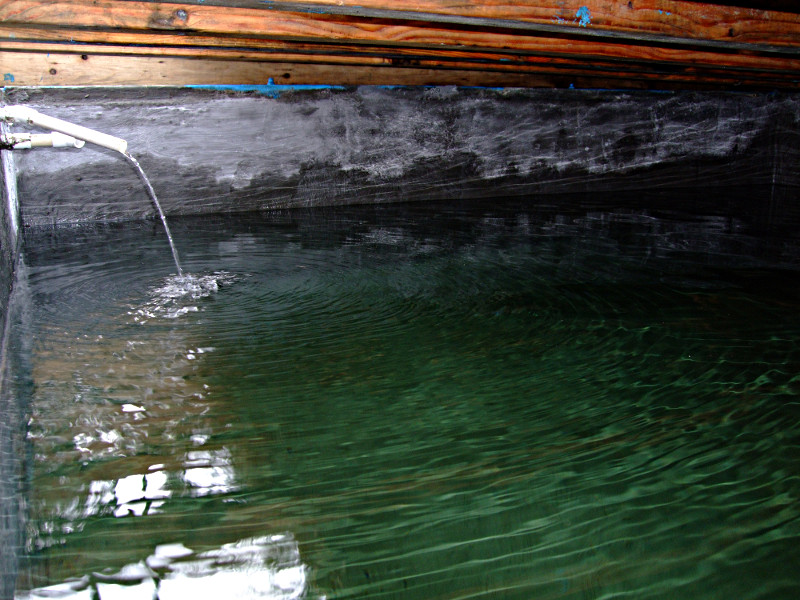 The cistern is full as of May 10 2011. The pipe is 50 inches long (47 inches under water). This view is looking down into the cistern The cistern took 7 and 1/2 days to fill. The fiters' flow rate is 52 litres per hour. 9450 liters at 52 litres per hour = 181.73 hours to fill or 7.572 days So far, it looks good. No measureable leaking in 7.5 days. 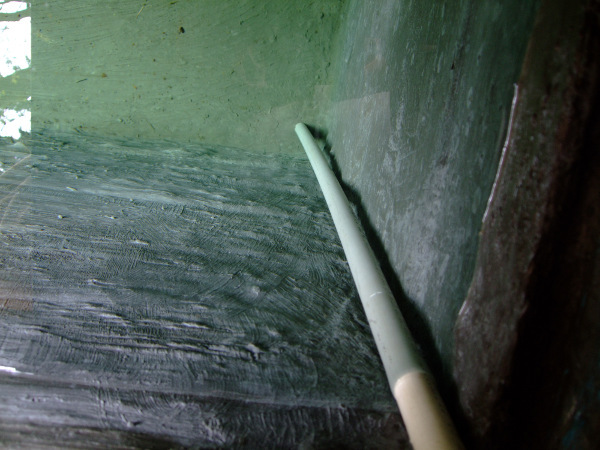 |
|
The galvalume roofing on the cistern top May 2 2011.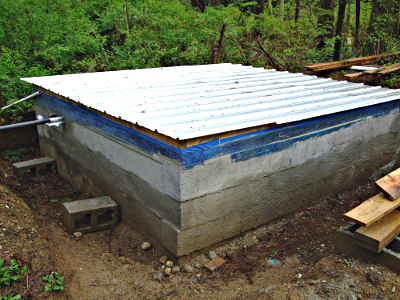 |
4 by 4's support 1/2 inch plywood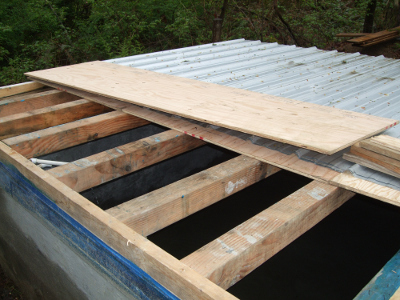 |
|
2010 Cistern with the ansi-61 coating June 2010 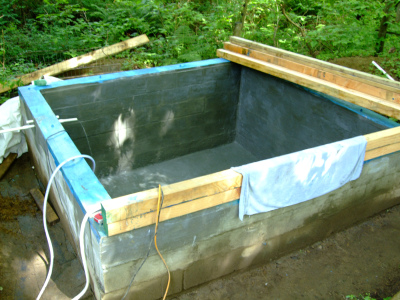 |
2010 The modified version starting to fill June 2010 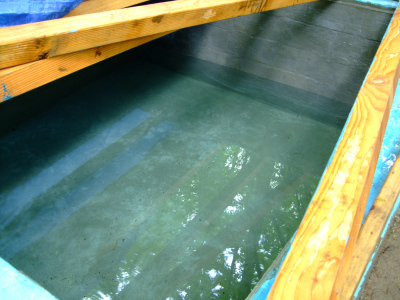 |
| The modified version almost full: 5 bricks under water -
and one still above. June 12, 2010. Will the cement hold over time? - that is a good question. 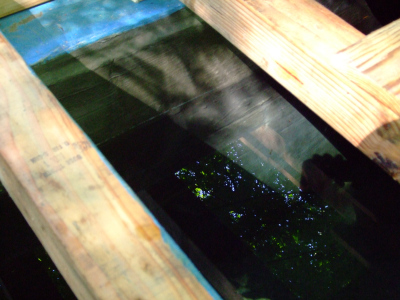 |
This is the modified cistern full of water June 30 2010. The
green color is from the cement and the reflection from the big leaf maples above. In the lower left corner the short pipe is the input and the long pipe is the output Fresh water is always coming in the top. 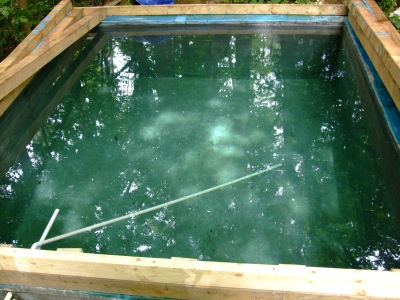 |
Below are pictures from Late April and early May 2010:
 |
Below is the cistern with all the
rough edges and chips on the sides removed with the use of a wire
brush; and the sill plates installed.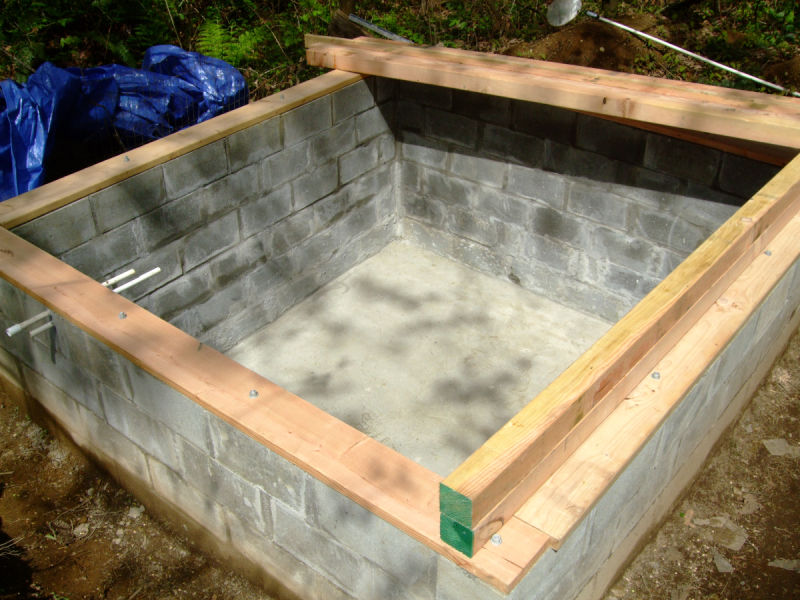 |
Below is the cistern with rubber sealer coating (first coat). It is a non-toxic potable water approved rubber sealer. In this situation the sealer did not work because the concrete blocks were absorbing too much moisture from the surrounding soil. This image below is shown for reference only. The cistern is not sealed with this product. In this part of the country it is too cold and wet for this sealer to work on a concrete block cistern underground. See the note for August 6 2012 at the top of this page for an alternative sealer suggestion. 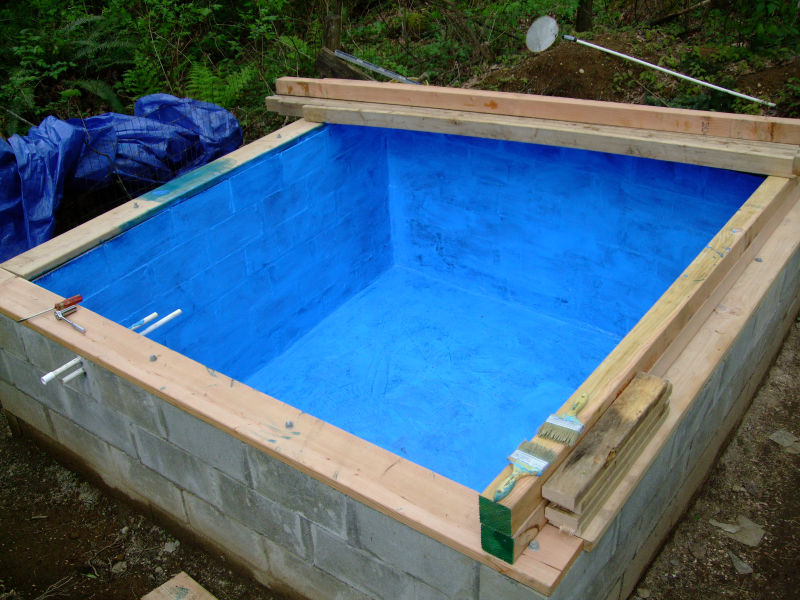 |

This work is licensed under a Creative Commons Attribution-Noncommercial-Share Alike 3.0. terms of use
